


 Sustainability and Energy
 Process Control
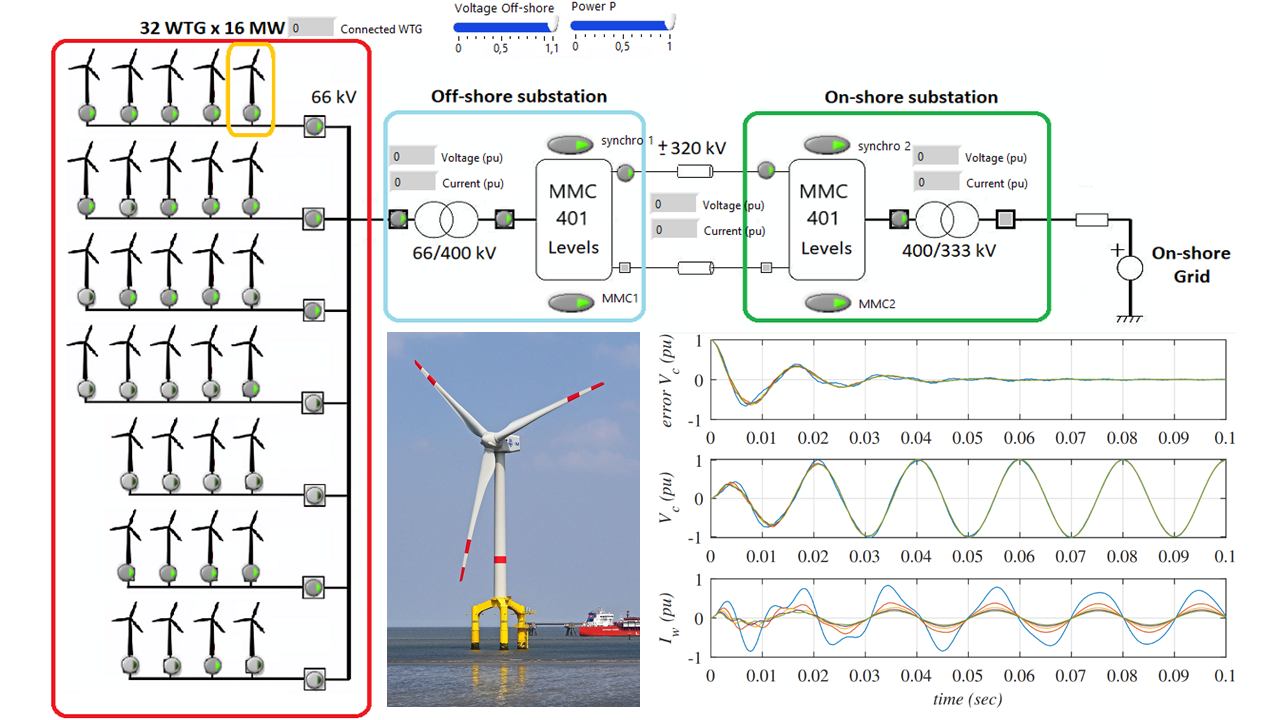
Advanced grid forming (GFM) control of generation and demand could allow the installation of additional 60GW additional renewable energy generation in Spain of which 10GW would be connected to the distribution grid with little or no re-enforcement. Additionally, grid-forming control could allow to reduce the 20% minimum synchronous generation currently required for safe system operation.
However, the current industrial experience of GFM devices is still very limited, particularly at the distribution level, where stability, protection, islanding and quality of supply risks are limiting the renewable generation connection capability.
At the same time, new technology advances are creating challenges which can be, in part, addressed by enhanced GFM control approaches. This proposal aims at the development of enhanced GFM Control and Protection (C&P) solutions to increase renewable capacity at little marginal cost and its use in three specific application scenarios.
Therefore, the first specific objective is the development of enhanced GFM control and protection for generation and demand to increase capacity at weak buses without compromising transient stability and robust to changing resonances close to the fundamental frequency.
The developed control strategies will be used in three different application scenarios:
- New grid-forming control and converter topologies for the connection of large-scale PV and off-shore wind with 132kV collectors to HVDC grids;
- Grid forming loads: Contribution of demand (variable speed pumped hydro storage in pumping operation) to the stability and controllability of the complete system and
- Co-ordinated GFM control and protection to increase connection capability, particularly in distribution grids.
These objectives are aligned with those of the National Plan of Scientific and Technical research and innovation (PEICTI 2024-2027) and of the National Integrated Plan of Energy and Climate (PNIEC 2023-2030) as published in sept 2024.
The expected contributions of the project are:
- Design of GFM controllers to increase capacity at weak buses without compromising transient stability and robust to changing resonances close to the fundamental.
- Development of advanced converter topologies and control strategies for integrating large renewable plants (wind and PV) with ±525kV HVDC grids, including dc-grid voltage regulation and scalability to giga-watt PV plants. This would allow a cost reduction on large scale off-shore wind and large PV integration.
- Grid-forming control for variable-speed pumped hydro storage to improve system strength, inertia, and stability, especially in pumping mode and near HVDC stations.
- Development of GFM control and protection methods to contribute to increase distribution network connection capacity without the need of Synchronous Condensers and the deployment of GFM embedded generation into distribution networks safely and effectively.
Advances on the proposed objectives can contribute to important cost savings in all considered scenarios. For example, objective 4 can contribute to savings in excess of 800MEuro, while contributing to the PNIEC goal of 19GW of embedded generation.