


 Health and Functional Quality of Life
  Industrial Processes. Smart Factory
 Industrial Informatics
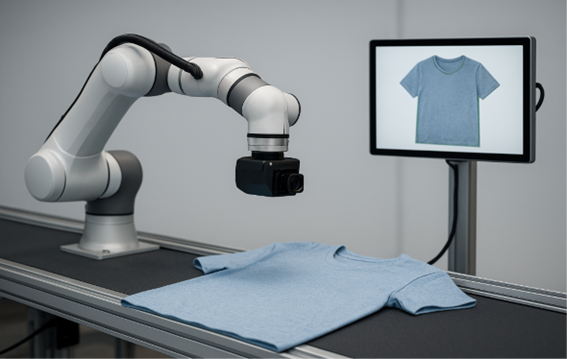

The CLOTHIA project (CLOTH Inspection & Automation with AI) has the goal of developing an integral, automated, and intelligent technological solution for the identification, manipulation, and classification of garments or textile objects. The project arises as a response to growing European regulatory pressure (such as the obligation for separate collection of textile waste before 2025) and the absence of mature technological solutions to address the increasing volume of textile waste.
The technological solution combines advanced robotics, multimodal perception (NIR hyperspectral vision and tactile sensors), and Artificial Intelligence (AI) to give a robotic system the capacity to manipulate deformable and flexible textile objects. The system will assess the physical condition (defects, stains, wear) and accurately determine the material composition of the garment, even in mixed materials. This automated classification will allow for deciding the optimal destination for each garment (reutilization, repair, or recycling), overcoming the limitations of current manual processes and increasing traceability and efficiency. CLOTHIA is positioned as a pioneering solution that drives the textile sector’s transition toward a truly circular model.
Objectives
The main objectives of the CLOTHIA project are:
- To develop an integral technological solution for the identification, manipulation, and classification of textile garments, facilitating optimal decisions in reutilization, recycling, or recovery processes.
- To integrate advanced robotics, multimodal perception, and artificial intelligence to manipulate deformable textile objects and evaluate their physical condition and material composition with high precision.
- To design and validate adaptive robotic manipulation (MMR) solutions for textile garments, optimizing gripping strategies according to the garment type and properties.
- To research and implement an advanced perception pipeline (MPC/MPM) that integrates visual (RGB) and spectroscopic sensors, capable of automatically detecting the garment type, its state of conservation, and the material composition.
- To develop and manage an intelligent inspection models system (MLOps) for the deployment, update, and continuous improvement of AI models in industrial environments.
- To evaluate the system’s operation, performance, and acceptance through validation pilots in both controlled environments and a real plant (TRL6).
Partners
The CLOTHIA project is being developed in consortium with the following entities:
- Universitat Politècnica de València (UPV) (Coordinator)
- Asociación de Investigación de la Industria Textil y Cosmética (AITEX) (Technological Institute)
- Nuevas Técnicas de Automatización Industrial S.L. (NUTAI) (Company)
- EXOS Solutions S.L. (EXOS) (Company)
- KOOPERA SERVICIOS AMBIENTALES S. COOP. (KOOPERA) (Cooperative Society)
UPV’s Role in the Project
UPV participates in the CLOTHIA project through the Instituto de Automática e Informática Industrial (ai2) and the Centro de Investigación de Ingeniería y Gestión de Producción (CIGIP).
- Coordination and Management: UPV is the applicant entity and project coordinator. It leads the Technical and Ethical Coordination and Management (PT1), ensuring the quality of results, ethical compliance, privacy, and data governance.
- Robotic Manipulation: UPV leads Work Package 4 (PT4), focused on Robotic Manipulation and Adaptive Learning. This includes the development and implementation of the Robotic Manipulation Module (MMR), adaptive gripping systems (soft grippers, vacuum), and control and autonomous operation strategies for handling deformable textiles. It also performs functional validation in a simulated environment.
- Multimodal Perception and Intelligent Inspection: Through ai2, UPV actively participates in the tasks of Multimodal Perception and Intelligent Inspection (PT3).
- Deployment and Maintenance: Through CIGIP, UPV actively participates in the tasks of developing the platform for the deployment and maintenance of AI models (PT5).
- Transfer and Dissemination: It collaborates in Communication, Transfer, and Standardization (PT7), defining strategies for the exploitation of results and connection with the business ecosystem.